The Ram Raavan debate by high heels and designer haircuts!
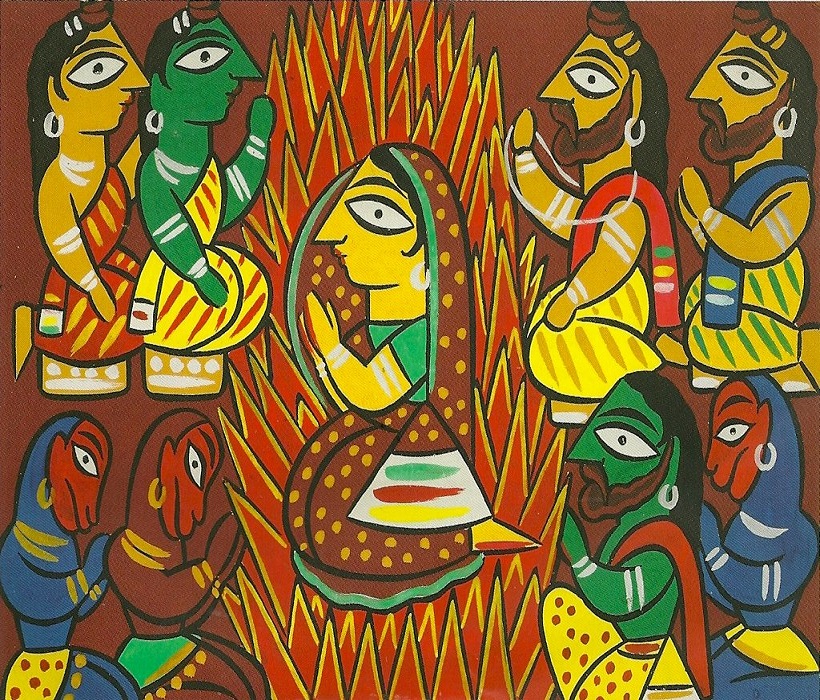
During Dusshera I have seen many posts and articles questioning the tradition of Ram-leela, wondering why people worship Ram who doubted his wife over Raavan who abducted but never touched Sita!
Without sounding rude, arrogant or aggressive, I really wish people had read the epics beyond those Class 2 level comic strips. They would then have realized that everything in the epics are metaphorical, hinting at profound philosophy and learning.
The Ram-Raavan conflict never started with either of these two protagonists. It started with Surpanakha and Lakshman, who acted as catalysts to the great war. The battle between Ram and Raavan was more than personal; it was the battle of Dharma!
Raavan had been introduced as a great ruler in The Ramayana; he was pious, learned and powerful. So much so, that after defeating Raavan, Ram himself went to pay homage to the dying ruler of Lanka.
But still, Raavan is burnt on Dussehra as a sign of the end of evil and victory of goodness. Why?
Raavan being a great king, fell prey to Maya, the illusion of emotions. Surpanakha’s demands from Lakshman were not fair. Yet he chose to stand by his wailing sister, instead of taking a fair stand which is expected from a king. Instead of acting as a guide and an influencer, Raavan played the role of a brother. This was not only his failure as a king, but also the first call of evil. The second call of evil was the fact that Raavan went on an ego trip while avenging his sister’s humiliation. He lost his sense of righteousness. He fell slave to anger, and committed many sins in the process, one of them being the killing of Jataayu. Shastra’s mention that slaying someone weaker than you is “misuse of power”. Hence, attack over the weaponless, child, old or handicap is a sin, unless it is done for defense.
Every year Raavan is burnt as a symbol of the destruction of ego, attachment, anger, impulse, etc. all of which are counted as the seven deadly sins under Indian mythological and philosophical texts.
Coming now to Ram doubting Sita.
Ram never doubted Sita; his subjects did. Had Ram doubted Sita, he would have either abandoned her or transformed her like he transformed Ahalya from rock to life. Once again here, the law of Dharma played. Being the king, Ram had to leave his personal emotions behind and stand by the people.
A woman can be a man’s greatest strength; and she can also be a man’s greatest weakness. The people of Ayodhya wanted to know whether their queen had betrayed the king, metaphorically trying to test whether the queen was the king’s strength or weakness. Ram chose to let things get proved right in front of them instead of shutting them off. The people had the right to understand whether they were in right hands. And the king was answerable.
Sita returning unscathed from the fire test was metaphorical again, symbolizing that the doubts of the people questioning her character, which were as scorching as fire, could bring no harm because she was the face of truth.
Years later, when Sita was asked to take the fire test for the second time, she chose not to oblige. However, in her decision, she didn’t violate her Dharma. As a queen answerable to her subjects, she asked mother Earth to shelter her.
Earth is a part of Nature. Nature, that works at its own whims mercilessly, did not turn its back at Sita. Such is the power of a woman, in Indian epics…she can alter the rules of nature! The Earth opened its arms at Sita. Instead of going through fire, which also is an element of Nature, Sita made her protest felt by submitting herself permanently to the Earth, simultaneously proving her truth to the people once again.
The Indian epics aren’t as easy as a first read feels. Neither are they a collection of unrelated, regressive short stories. Sages who wrote them were more scientific than our architects and engineers today; they were technically more advanced than our social media knowledge.
Requesting the world to consider this, for once!
Image Source : Flickr
